It's 7:40 on a Friday evening. Salary has just hit accounts, your campaign is live, and sign-ups are climbing. Then the PAN verification API you depend on starts timing out.
Nothing crashes. The app just spins. And users who were one tap away from becoming customers quietly close the tab.
If you've run onboarding at a fintech, NBFC, lending app or broking platform in India, you've probably lived a version of this evening. The usual reaction is to blame the vendor and start shopping for a better one. But the problem isn't that you picked the wrong provider. It's that you're relying on only one. That's the gap KYC orchestration fills.
What is KYC orchestration?
KYC orchestration is a layer that sits between your app and multiple KYC providers. It sends each identity check (PAN, Aadhaar, bank account, face match) to the provider most likely to succeed, and automatically retries with another if one fails.
In practice, your developers integrate once. Behind that single API, the orchestration layer connects to several verification vendors, watches how each one is performing, and decides in real time where every request should go. You'll also hear it called identity orchestration or multi-vendor KYC. Same idea.
If this sounds familiar, it's because payments went through the same shift years ago. Nobody serious runs on a single payment gateway anymore. KYC is simply catching up.
What a KYC provider outage actually costs you
KYC is the step where users are most likely to drop off anyway. They're being asked for documents, a selfie, maybe their Aadhaar OTP. Add a spinner that never resolves, and you've given them the perfect excuse to leave.
We won't throw industry-wide stats at you. Every business is different. Instead, here's a simple worked example. The numbers below are illustrative assumptions, so swap in your own.
Now the math:
- Lost sign-ups: 1,200 × 50% = 600 people who wanted to join and couldn't.
- Lost customers: 600 × 30% = 180 active customers who never happen.
- Lost first-year revenue: 180 × ₹2,000 = ₹3.6 lakh.
- Wasted acquisition spend: 600 × ₹300 = ₹1.8 lakh already paid to bring users who then walked away.
That's roughly ₹5.4 lakh from a few bad hours in a single month. And it doesn't count the softer costs: support tickets from users stuck mid-flow, a manual review queue that suddenly balloons, and the one-star "app doesn't work" reviews that keep costing you long after the vendor has fixed things.
One more thing worth knowing. Outages aren't always dramatic. Often a provider stays technically "up" but gets slow, or its match rate for one document type quietly drops. Those partial failures rarely show up on a vendor status page, yet they bleed conversions the same way.
To run this for your own funnel, use: users hitting KYC during degraded periods × abandonment rate × activation rate × revenue per customer. Then add the wasted acquisition cost on top.
How KYC routing and failover work
An orchestration layer makes one decision for every single check: which provider should handle this request right now? It answers that using three signals.
1. Success rate. How often has each provider returned a clean, valid result for this check type recently? A vendor might be excellent at PAN verification but weaker on bank account validation. Routing follows the evidence, not a contract signed two years ago.
2. Speed. Response times drift through the day. If one provider's verification time creeps from one second to six during peak hours, traffic moves to a faster one before your users feel it.
3. Cost. Not every check needs your most expensive vendor. A cost-aware setup can try the cheaper provider first and escalate only when it fails or when the result needs a second opinion.
You set the rules. For example: "Send PAN checks to Provider A. If its success rate drops below 95% over 15 minutes, or a response takes longer than 3 seconds, move traffic to Provider B." Those thresholds are examples, and you'd tune them to your own risk appetite.
What happens when a provider fails
This is where KYC API failover earns its keep. Here's the life of a single request:
- Your app sends one API call to the orchestration layer.
- The router picks Provider A, the best performer for that check right now.
- Provider A times out or returns an error.
- The router retries the same check with Provider B, automatically, without the user doing anything.
- Provider B verifies the user. The result comes back to your app in one standard format, so your code never needs to know which vendor answered.
- Every attempt is logged, so you have a clear record of how each customer was verified when auditors or compliance teams ask.
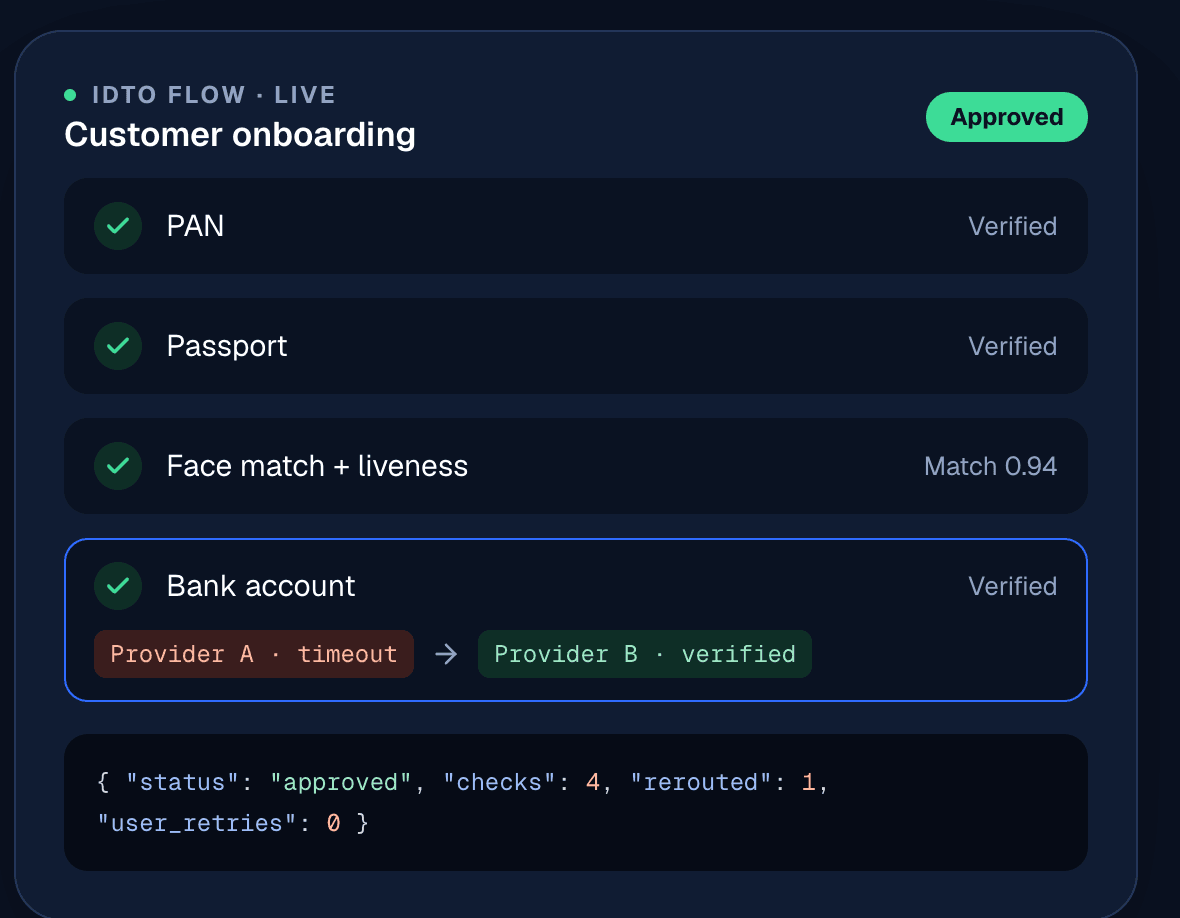
The user, meanwhile, sees a slightly longer loading state at worst. Compare that with an error screen and a "please try again later" message. That's the difference between a completed sign-up and a lost one. You can see how this works on idto's KYC orchestration page.
Single provider vs. building in-house vs. KYC orchestration
Once teams feel the pain of a single vendor, there are really three paths. Here's how they compare.
Building in-house isn't a bad idea. It's just a bigger commitment than it looks on a whiteboard. The first two integrations are the easy part. The hard part is the monitoring, the retry logic, the edge cases and the 2 a.m. alerts that come after.
Five signs your team needs KYC orchestration
Not every business needs this on day one. But if two or more of these sound familiar, you're probably past the point where one provider is enough.
1. You're already juggling multiple vendors
One vendor for PAN, another for bank verification, a third for video KYC. Each has its own dashboard, its own error codes and its own invoice. Your developers have become the glue holding it together. Orchestration gives all of it one front door.
2. Outages are no longer rare
If your team has a Slack channel just for "KYC is down again", that's your sign. Provider downtime and slowdowns are a normal part of working with external APIs. The question is whether your users feel them.
3. Verification costs keep climbing
As volumes grow, per-check costs add up fast. If you're paying premium rates for every check, including the simple ones, cost-based routing can bring the average down without lowering quality.
4. You need new checks, quickly
Product wants to add face match, CKYC search or DigiLocker document pulls next quarter. With a single vendor, you're stuck with whatever they offer. With orchestration, adding a check is closer to flipping a switch than starting a project.
5. You're expanding into new markets or products
A new lending product, a new customer segment or a move beyond India brings new ID types and new regulations. No single provider covers everything well. An orchestration layer lets you add regional or specialist providers without rebuilding your onboarding flow.
Frequently asked questions about KYC orchestration
No, not in any way your users will notice. The routing decision itself takes milliseconds. In most cases orchestration actually makes verification faster, because it steers requests away from providers that are running slow. The only time a check takes longer is during a failover, and a few extra seconds is far better than a failed check and an abandoned sign-up.
Yes. Orchestration doesn't mean ripping out vendors you already trust. You can keep your current providers and contracts, plug them into the orchestration layer, and add backups alongside them. Your existing vendor simply becomes one of the routes.
Not quite. An aggregator gives you access to several checks through one API, but usually routes each check to a fixed provider. Orchestration adds the intelligence on top: live routing based on performance and cost, plus automatic failover when something breaks.
It shouldn't be. A well-designed orchestration layer sends each request only to the provider handling that specific check. That matters for data minimisation, and for staying on the right side of India's Digital Personal Data Protection (DPDP) Act.
No. Large enterprises feel outages more because of volume, but smaller teams often feel them harder. They have fewer engineers to build workarounds and less room to absorb lost sign-ups. If onboarding is central to your growth, orchestration is worth considering early.
One provider is a single point of failure
KYC is the front door to your business. Every user you've paid to acquire has to walk through it. Leaving that door dependent on one vendor's uptime is a risk most teams only notice after their first bad Friday evening.
KYC orchestration takes that risk off the table. Your app makes one call. The routing layer finds the best provider for every check and quietly switches when one stumbles. Your users never see the difference, and your conversion numbers stop depending on someone else's status page.
Want to see how it works in practice? Explore idto's KYC orchestration platform, or watch a check get routed and recovered in real time.
Stop onboarding from depending on one provider
See how idto routes every check to the best provider and fails over automatically.